

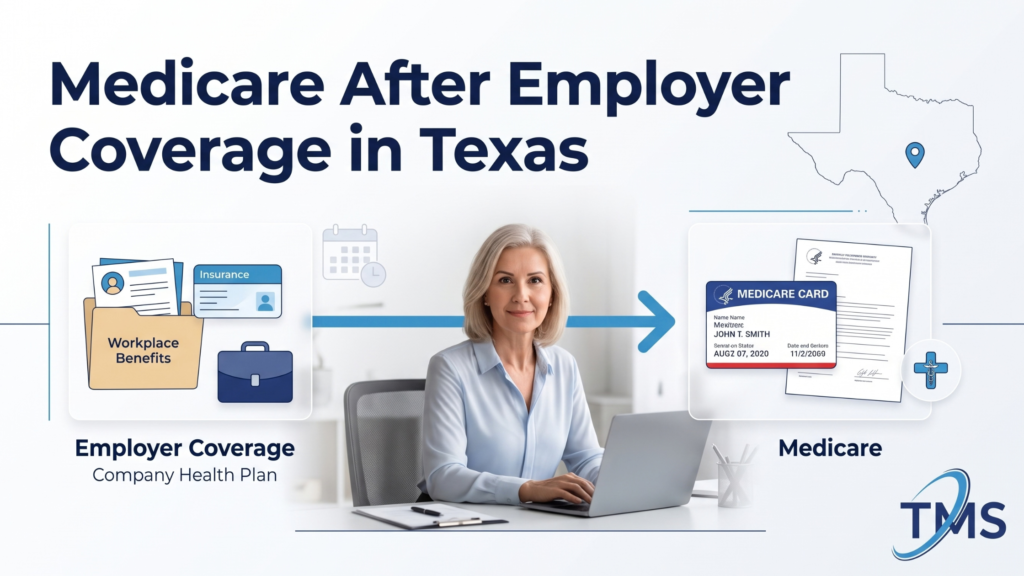
If you are retiring in Texas and leaving employer health insurance, start by confirming when your active coverage ends and whether you qualify for a Medicare Special Enrollment Period. In many cases, people who had qualifying group health coverage based on current employment can enroll in Part B while that employment coverage continues or during an eight-month period after the employment or coverage ends, whichever happens first. Your specific circumstances should be confirmed with Social Security.
The move from an employer plan to Medicare is a coordination task, not a one-size-fits-all switch. Texas Medicare Solutions is a BBB-accredited Medicare insurance agency, and our licensed insurance agents help Texas seniors organize questions about timing, prescriptions, doctors, and coverage categories in plain language.
What Changes When Active Employer Coverage Ends?
While you are actively working, your employer plan may pay first or second depending on the employer’s size and other Medicare coordination rules. When the job or group coverage ends, Medicare may become the primary coverage if you are eligible and enrolled.
The exact coordination rules depend on your circumstances, so ask your benefits administrator and Medicare before your last day.
Make a simple timeline with four dates:
- Your final day of employment.
- The last day of active employee health coverage.
- The date Part A or Part B will start.
- The date any Medicare Advantage, Medicare Supplement, or prescription drug coverage would begin if you choose one of those coverage options.
These dates do not always match. A retirement date, a benefits end date, and a Medicare effective date may fall in different months.
What Is the Special Enrollment Period After Retirement?
A Special Enrollment Period, or SEP, may allow someone who had qualifying group health coverage based on current employment to enroll in Part B without waiting for the General Enrollment Period.
For many people, the Part B SEP is available while they are still covered by the group health plan based on current employment and for up to eight months after the employment or that group health coverage ends, whichever happens first.
Social Security can confirm whether your employer coverage qualifies and what documentation is required.
Do not wait for a final paycheck to begin gathering documentation. Ask your benefits office for records showing coverage dates and that the insurance was based on current employment. If Social Security requests an employer form or other proof, return it promptly and keep a copy.
Does COBRA Count as Active Employer Coverage?
COBRA can let you continue an employer plan after employment ends, but COBRA is not considered group health coverage based on current employment for purposes of the Part B Special Enrollment Period.
Choosing COBRA generally does not restart or extend the eight-month Part B SEP. The SEP is tied to the end of the employment or the qualifying group health coverage based on that employment, whichever happens first.
Retiree coverage and individual health insurance can follow different Medicare enrollment rules as well. This distinction is important because a person may still have an insurance card while needing to resolve Medicare enrollment.
Before choosing COBRA as a bridge, ask:
- How does COBRA coordinate with Medicare?
- How long will COBRA coverage last?
- How will prescription coverage work?
- Will the plan pay claims differently after you become eligible for Medicare?
- When does your Part B enrollment window end?
Get answers in writing and confirm Medicare enrollment timing with Medicare.gov or Social Security.
What Should I Review Before Retirement?
Your health needs and budget may change after employment ends, so create a review list before comparing Medicare coverage categories.
- Doctors and facilities. List the doctors, clinics, hospitals, and specialists you use. Note whether you receive care in more than one Texas county or travel out of state.
- Prescriptions. Record each medication, dose, and pharmacy. Prescription drug coverage rules can differ, so use current official plan information and Medicare Plan Finder when reviewing available options.
- Employer benefits. Ask whether dental, vision, hearing, retiree coverage, or a health reimbursement arrangement continues after employment.
- HSA contributions. Medicare enrollment affects HSA contribution eligibility. In some situations, premium-free Part A can begin retroactively when someone enrolls after age 65. If you have an HSA, ask a qualified tax professional or benefits administrator when contributions should stop.
- Income changes. Retirement may change your income, but Medicare income-related adjustments use federal income information under specific lookback rules. Review official Social Security notices rather than estimating the adjustment from a single month of income.
- Travel and family support. Consider where you receive care and who may help you keep records or participate in discussions.
How Can I Avoid Gaps or Overlapping Decisions?
Start with Medicare enrollment and effective dates, then review additional coverage categories.
Keep your employer plan documents until claims from the final coverage period are processed. Do not cancel active coverage until you understand when Medicare begins, how the two coverages coordinate, and whether any additional coverage you are considering will be available when you need it.
Create a short question list for every conversation. Ask:
- Who pays first?
- Which date controls my enrollment deadline?
- When will Medicare coverage begin?
- How will prescriptions be handled?
- Who should I contact if a claim is denied?
Clear notes can prevent different family members from relying on conflicting information. Recheck dates if retirement is delayed or your employer changes the end date of your benefits.
A licensed insurance agent with Texas Medicare Solutions can explain how Medicare Advantage, Medicare Supplement, and prescription drug coverage work at a high level and help you organize questions about your transition.
For official Part A and Part B enrollment decisions and dates, contact Social Security or Medicare.gov. Your employer benefits office should confirm employer coverage details, and a qualified tax professional can address tax-specific HSA questions.
Frequently Asked Questions
Can I Get a Medicare Special Enrollment Period After Retiring?
You may qualify if you had group health coverage based on your or your spouse’s current employment. For many people, the Part B SEP lasts for up to eight months after the employment or qualifying group health coverage ends, whichever happens first. Confirm your specific eligibility with Social Security.
Does COBRA Count as Active Employer Coverage for Part B Timing?
No. COBRA is generally not considered coverage based on current employment for the Part B Special Enrollment Period. Choosing COBRA generally does not extend the Part B enrollment deadline.
Should I Cancel My Employer Plan When Medicare Starts?
Do not cancel coverage until you understand your Medicare effective date, how the coverages coordinate, and whether any follow-on coverage you are considering will be available when you need it.